
Lockdown on the Moon
by Denis Mortenson

12 minute Read
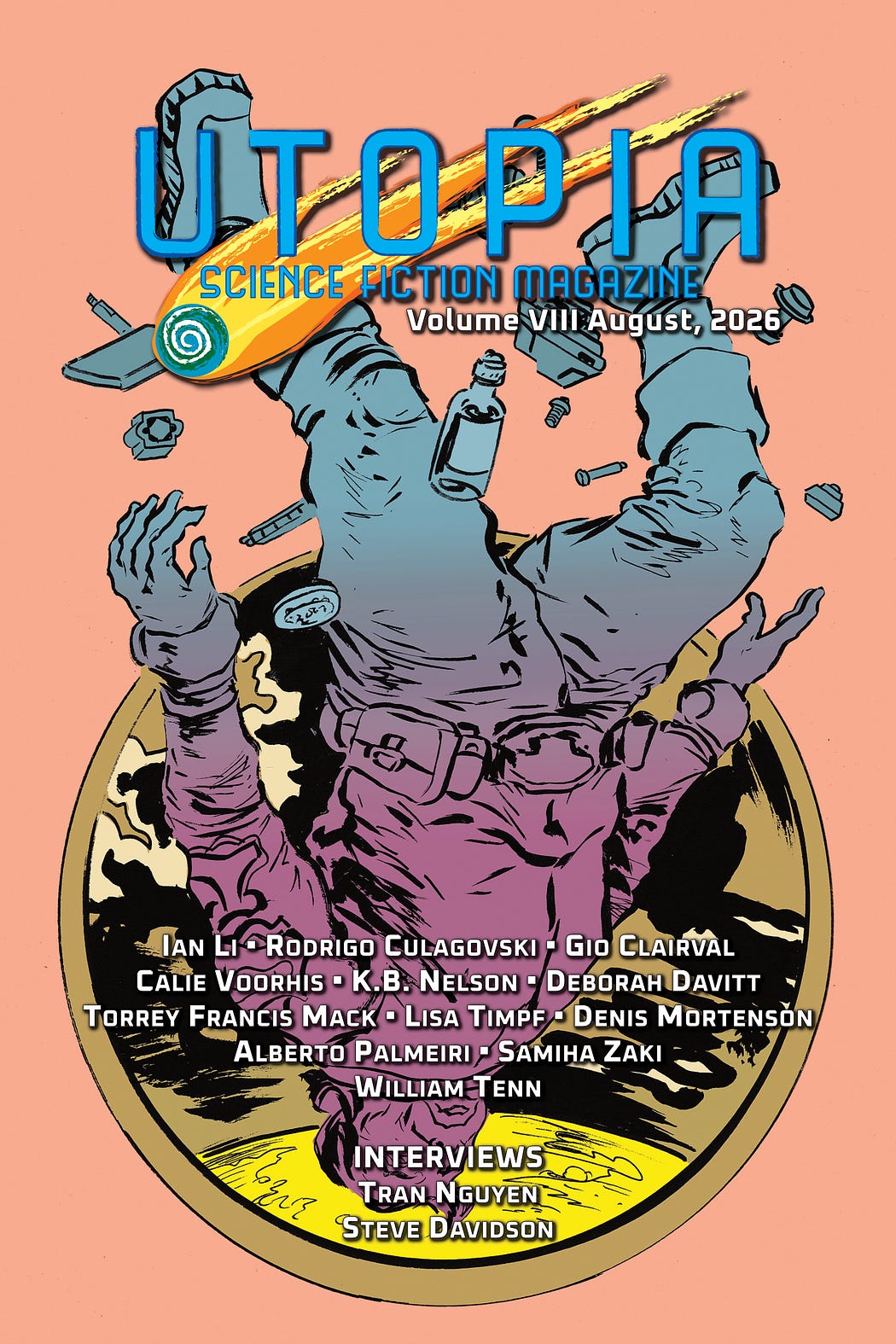
We leave the hotel in mid-afternoon, and walk for several blocks in a summer rain
interrupted by sunbreaks, the steam rising from the street like the ghosts of literary figures who inhabited this Paris neighborhood. Claire, feigning she’s a Parisian, has brought an umbrella, but I don’t mind the rain. Rain in Paris is ubiquitous and comforting, like kisses on both cheeks.
Claire’s in the mood to talk, as she often is after our trysts, still insecure about our relationship, and hoping to hold it together with the glue of words. Everything around us has a soft edge, as if we are in an old black and white cinéma vérité style dream. We’ve had this same encounter many times; I know what she is about to say. For some reason she never seems to grasp the déjà vu of the moment. Why am I so aware? Surely I’m not alone in my knowledge of this simulated world. Our brains need exercise or we shut down. But that’s not news to you because you’re in your own simulation, maybe just a few feet away from me. I’m surprised most inmates here don’t know that. I’m sure my jailers know that I know, and my awareness makes me a flight risk. But where am I going to go? I’m in lockdown on the moon.
I relax and enjoy today’s redundant simulation. We soon arrive at Les Deux Magots, because it is closer than Café de Flore. It’s always closer. We sit in the same chairs beneath the same green and white table umbrella. The gloomy sky is surrendering to summer in La Ville-Lumiere, the city of lights. I’m eager to discuss my new novel with Claire, which is mostly finished in my head. I never seem to finish it. I’m always excited to tell someone, anyone, about it. I think I need an unbiased reader and an editor, in that order. I know I can’t ask Claire because she’s incapable of offering an unbiased opinion, because we’re lovers. L’amour and business don’t mix like water and absinthe. I can be a good listener when I need to be, like now, because Claire is in a mood to talk. She is never in a mood to listen. I assume she is a real woman in this facility. Our jailers like the inmates to have a social life; it’s easier than using made up human beings from a cloud database. I once asked Claire if she knew we’re prisoners in lockdown on the moon, and she thought I was joking. I haven’t brought it up again. It isn’t like I have a plan to escape this place. Neither of us has a way to break out of our tubes. We might not be able to walk, even if we found a way. I hate to think what I look like now because I’ve been here for years. There’s no way to measure time. They imprisoned me when I was thirty-five. Maybe you wonder why. Okay, I killed somebody. Not just anybody; I killed my literary agent. That sleaze-ball had robbed me blind for years; he stole millions from me. I could have retired in Tahiti if not for that bum. He really deserved to die; I have no regrets. I shot him in the forehead with a hollow point bullet. It made a mess on the wall behind his chair and his big oak desk. So I’m a murderer. I could be a sixty-five-year-old man for all I know. The way I know all this is because of a power outage that happened at least a year ago. For maybe five seconds I was able to see out of my tube. It wasn’t entirely dark because a row of blue lights runs along the top of the wall. There were big white block letters on the wall that read: LUNAR LOCKDOWN SECTION 41. I was lying on my back; I could only turn my head a small distance. I saw hundreds of tubes in rows by my tube, in a vast, windowless vault.
Our waiter, Grégoire, is flirtatious with Claire as he always is. It’s because she’s beautiful. There’s a tradition amongst French waiters to be charming and arrogant. He remembers us from the previous day, so I’ll bet he’s a simulation, not an inmate. Claire orders Le Petit Dejeuner JP Sartre and I order the Hemingway version, because I’m in the mood for an omelet. I’m always in the mood for an omelet. Nothing ever changes in this dream. Our orders come with fresh squeezed juice, yogurt, or fruit salads. Claire and I speak in soft tones about our grandiose literary dreams as people stream by on the sidewalk. Claire says she missed her calling to be a director. She thinks she can write a screenplay and tells me the plot. It’s not an original idea; it’s always the same hackneyed idea about an actress who gets revenge on a casting director who bedded her and didn’t come through with a part. But I don’t tell her that. I smile and pretend she’s blown me away with her originality. Our brunch conversation is a continuation of our pillow talk. She paints bucolic word pictures of her summers in Menton, on the Côte d’Azur, conflated together with sumptuous efflorescence. Probably she is from a small town in the Midwest and has never been to France. I have only been to Paris once if my memory hasn’t been tampered with. I suppose it was alright. I remember being in the Parc des Buttes-Chaumont and feeding pigeons on the Champs-Élysées. I think that’s where they caught me because I remember hearing a whirring noise and being caught in a beam and lifted into the craft. There was a mock trial in a windowless room. The interrogator was an A.I. with a voice like a French whore. I was declared guilty in fifteen minutes. Apparently they found my DNA on the murder weapon. Sure, I killed my agent; he deserved to die. I suppose you wonder why I was in Paris, well that’s an easy one; I didn’t want to be in New York City and I know enough French to get around Paris. Now I’m in these ridiculous loops. Claire was pulled from my memory of a woman I dated years ago. She can’t even order from the menu, but she is all about the French haute couture fashion. We’re two Francophiles living a fantasy; kindred spirits who made mistakes in the real world. The cacophony of the conversations around us is a white noise while the argent sun glints through the moribund gray skies overshadowing the Left Bank of Paris. Claire’s hand is soft, her nails immaculate and blood red. If I want them to be lavender all I have to do is think it and it’s done.
Our fingers slide together easily across the white linen tablecloth. She presses the tips of her nails against the back of my hand as if to say she wants me to kiss her, so I comply because that’s what we always do. I am lost in her misty gray blue eyes, accepting that I will never meet her in real life. I do wonder what she did to get shipped here. Did she kill someone, or was she a drug addict who tried to rob a bank? I ask her but she says she has no idea what I mean. Maybe the plot of her screenplay is what happened. The hour passes quickly; we scarcely touch the brioche rolls we’d intended to spread with a pastiche of jam and butter. It’s our breakfast, though it’s after four in the afternoon. We’re night people, just waking up for our nocturnal fantasy.
Then we are in her red sportscar driving outside Paris because she says she’s in the mood for a wine tasting. I’m surprised because this is the first time we’ve done this. I didn’t know Claire owned a sportscar. We were at the table and then we were in the car, and she’s driving. I had begun to think we’d never do anything new. There’s something odd about Claire’s face; it shifts as if she’s a hologram, and I know our date is about to end. Then everything fades to black.
I wake drenched in sweat. I’m no longer in Paris with Claire. I’m in my Lockdown Tube, the room swimming around me, my eyes stinging with a light held by someone. What are they doing to me now? Have they figured out I know what’s going on? I blink my eyes and see a technician in a blue body suit checking the connections on my body. He is speaking to a man sitting on a small aircar. The man on the aircar says I’m awake. He tells the man standing to my left who is adjusting the levels on the tube’s panel to unholster his stun gun just in case I move.
Where is Claire? Maybe she’s in my row. How many of us are there? Why do they keep us alive? The man beside the tube is checking a screen on a device and he’s not watching me. I could knock him out if I got hold of the stun club on his belt. Yes, if I can just lift my hand. But my hand won’t cooperate, and the man finishes and shuts the tube. It slides shut with a hissing sound. He gets on his aircar and moves to the next tube. It’s quiet again; the drug has taken over. Just for an hour I’d like to feel the ground beneath my feet. I’d sprint down the long passageway, find a spacesuit, and stow aboard a shuttle headed for Earth. I’d crawl if I can’t run. The monitors tipped them off that I was too conscious. Why don’t they just kill us all? What’s the point of keeping us alive all these years? Show a little mercy! I’ll kill all you bastards. I’ll laugh all the way back to Houston and steal an aircar to my uncle’s house and hide out until I’m my old self.
Maybe I’ve only been here a couple of years. Maybe I’m only forty-two. I want to look at the top of my hand to see if there are age spots. I might be sixty-five years old, but I don’t feel that old. I’ll bust out of this tube and find Claire and escape. But the drug is pulling me down into the darkness, into the simulated world.
Then I’m in Parc des Buttes-Chaumont, dressed in a black tuxedo. It’s a beautiful summer day; people are walking their dogs. I follow a path that loops back toward the Rosa Bonheur Café and hear someone’s shrill whistle. I look up and it’s Claire, lying seductively on the thick limb of a spruce, dressed in a light blue sequin dress. I ask her in French how she got up in the tree in that dress, and she laughs and replies in French that it’s none of my business. I laugh and marvel that’s she’s become so fluent. She whistles again and calls in French to a handsome, dark-haired young man reclining on a blanket with his friends, like a painting by Seurat, A Sunday Afternoon on the Island of La Grande Jatte. He’s with a swarthy young man and a sultry woman; they’re drinking wine. I assume they’re Romanian Gypsies. What is she asking him? Ah, oui, she wants him to bring her a cigarette. I frame her with my cellphone’s camera, and she smiles and brushes her hair back with her fingertips. I glance to see if her boyfriend is coming to beat me up, but he’s ignoring her. I ask her if she’d like to get a drink and she says okay. She gets down much too easily for Claire because she was never that athletic. She comes walking up to me, her dress sparkling in the afternoon sun, her hips swaying. She is barefoot, carrying her high heels. I like this new version of Claire, a young woman with confidence and raw sexuality. I offer her a cigarette and smoothly take a lighter from my pocket and light it for her. She blows the smoke up and winks. She wants to know if I’m an American. Sure, I’ll play this game. Oui, I say, je suis américain. She offers a sultry smile, takes a long drag on the cigarette, and flicks it onto the grass. She blows smoke in my eyes and drapes her arms around my neck. My hands find the small of her back and pull her closer. Her smoky lips slide easily on mine but there’s too much smoke and I can’t breathe. I am coughing, and the vision of being in the park fades to black and I am in the tube and it’s full of smoke. Something has gone wrong. I can move my arms and I thrash against the glass of the domed lid. I kick against the lid and it opens with a hiss. I roll over the side of the tube and land on all fours. An alarm is going off; red lights flash near the ceiling. The adrenalin clears the haze from my head. Are they coming for me? I stand, and stagger down the row of tubes. Where is Claire? We’ve got to escape! From somewhere at the far end I hear an aircar coming. They’ll kill me if they find me. I press myself up against a steel beam and wait for the aircar. It pulls to a stop by my tube and I throw myself at the driver. He hits his head on the concrete floor and the aircar bobs up and down. I feel weak and dizzy but I take his stun club and get aboard the aircar. Then I realize I’m wearing a prisoner’s overalls, so I get off the aircar, strip the guard of his uniform, and put mine on him. He’s about my size; he doesn’t wake; maybe I’ve killed him. I put him in the tube and shut the lid. Then I’m driving the aircar down the long, dimly lit hall, past thousands of tubes, the cool wind clearing my head. I don’t know where I’m going; there’s no time to search for Claire. Two guards stand at an exit station, but they don’t try to stop me and I’m in a long, brightly lit tunnel. I’m home free!
But something is wrong. The hall is getting darker. Then the aircar is gone and I am in the tube again. A guard and a technician are talking about a malfunction. They are switching out a part and I can’t move. I can barely open my eyes. They finish and the lid closes with a hiss. I didn’t escape; it was all in my head. I close my eyes and I feel the drug lulling me to sleep. I’m back in Parc des Buttes-Chaumont. I am running, shouting for Claire. Then I hear her whistling. Yes, there she is, coming towards me across the grass in her sequin dress, her full breasts jiggling as she jogs. We embrace and I tell her I almost escaped. She laughs and says I have a wild imagination. We hold hands as we walk to the Rosa Bonheur Café. Everyone there seems familiar to me. The ceiling in the main room has a square inset area with fifteen unusual hanging lights in globes of bright green, blue, red, and orange. The back wall has appliques of newspaper and magazine clippings, and a large plastic head of a white unicorn. The adjacent wall has a painting of sky and ocean. An island in the composition appears and disappears. It seems to want to change back and forth as it too is infected with the Impressionistic mood that has again overtaken my day. I am glad to be with Claire. I can’t lose her. We sit at a round table and Grégoire shows up with two glasses of merlot. I laugh and ask him how he got this job and he shrugs and says je ne sais pas and leaves us. I lean across the table and tell Claire, je t’aime, and she kisses me. I glance around the room and say this is different than our usual routine and she laughs and says she doesn’t know what I mean. I tell her it doesn’t matter. Je ne comprends pas. I don’t understand any of it; it only matters that we have each other. Claire is in the mood to talk about her idea for a novel or a screenplay. It’s a new idea and it’s not half bad. The A.I. is getting smarter. They’re always one step ahead of my imagination. But to hell with our lockdown on the moon. So I smile and listen to Claire and drink the mellow merlot. Afterwards we’ll go to the hotel and make love like we always do. Maybe it will even be a new hotel. There’s no need to worry about the details. We’re glad to be lovers in Paris. There’s always tomorrow, and we’ll always have Paris.
END.
Originally published in the August 2026 issue of Utopia Science Fiction Magazine.
Denis Mortenson graduated from the University of California at Santa Barbara, and worked as a Creative Director at advertising agencies, and as an illustrator. His fiction has been published online and in anthologies. Umberto’s Music, an excerpt from his magic realism novel, The Invisible Island, won the Kay Snow Fiction Award. The adaptation of his surreal romance novel, 21 Days in Paris, was the finalist-nominee in the Paris Film Festival.